
Lightning and Surge Protection for 4G/LTE Cell Sites with Remote Radio Heads (RRH/RRU)
Posted on: 2/2/26
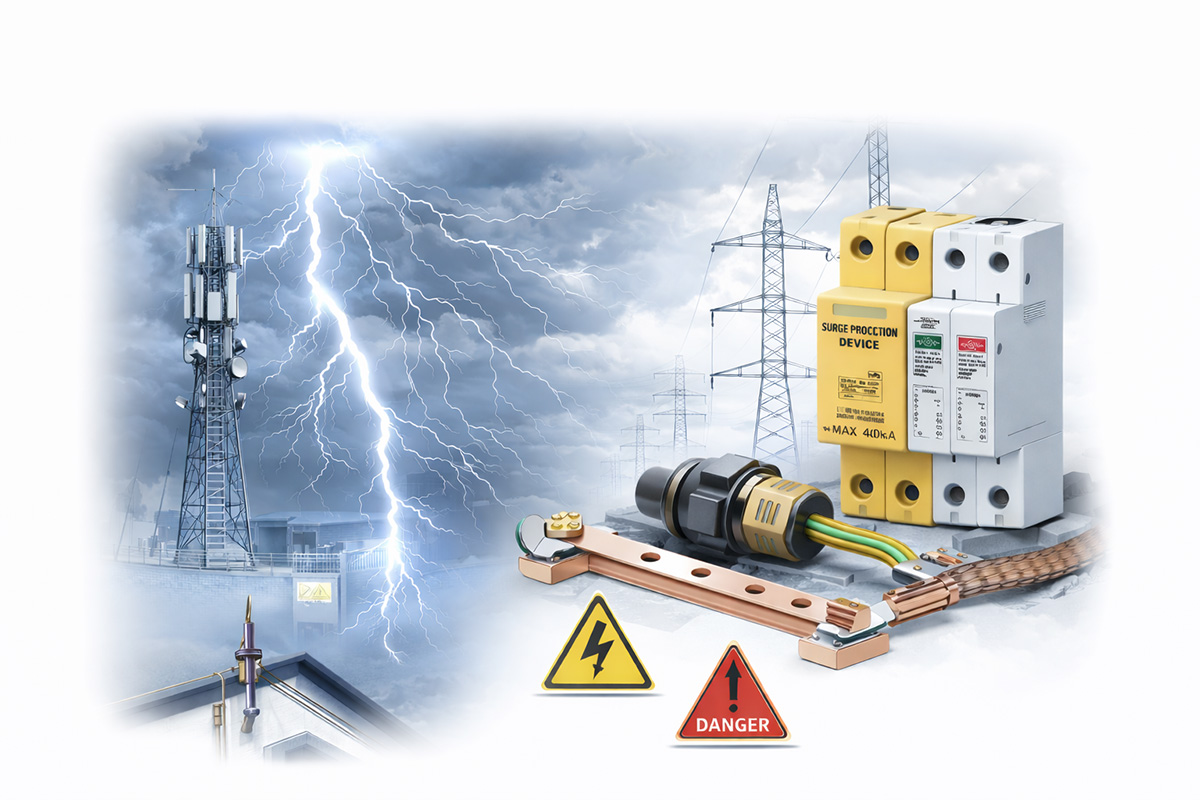 Modern mobile communication networks rely on the continuous operation of 4G/LTE cell sites, many of which are now built using remote radio head (RRH/RRU) architectures.
While these systems improve bandwidth, energy efficiency and network performance, they also introduce new electrical risks. Telecom infrastructure is often installed in exposed locations—on rooftops, masts, and remote compounds—making it highly vulnerable to:
-
Direct lightning strikes
-
Partial lightning currents
-
Transient overvoltages
-
Induced surges on power and data lines
This article provides a technical overview of best-practice lightning and surge protection for cell sites, with a focus on coordinated protection for:
-
AC mains power feeds
-
48 V DC RRH feeder circuits
-
Telecom distribution boards
-
Monitoring and maintenance reliability
All recommendations are based on recognised surge protection principles and the reference white paper on LTE site protection.Click here
The Shift to Remote Radio Head Technology Increases Exposure
Conventional base station designs placed most radio transmission equipment inside the technical room, with antennas connected using coaxial feeder cables.
However, coaxial cables introduce significant transmission losses—often up to 50%, depending on length and cross-section. This also increases the need for cooling systems, raising operational cost.Click here
Modern LTE deployments increasingly use remote radio heads/units, where RF electronics are mounted directly at the antenna.
Key advantages include:
-
Reduced signal loss
-
Improved transmission speed and range
-
Lower cooling requirements
-
Smaller base station rooms or outdoor cabinets
-
Fibre-optic data transmission up to 20 km
But this architecture places critical electronics directly in the lightning exposure zone, requiring robust protection at multiple levels.
External Lightning Protection for Rooftop and Mast Cell Sites
Many telecom antennas are installed on rented rooftops or shared infrastructure. Building owners typically require that the antenna system does not introduce additional lightning risk.
This means that lightning currents must not enter the building structure.
The white paper describes the use of isolated air-termination systems, where the air rod is mounted using non-conductive support tubes. This ensures antennas and RRHs remain inside the protected volume while lightning current is safely diverted externally.
A properly designed lightning protection system prevents dangerous partial lightning currents from flowing into:
-
Base station electronics
-
Power supplies
-
Network transmission systems
-
Building electrical installations
Surge Protection for the AC Power Supply of Base Stations
The AC power supply is one of the most critical entry points for lightning surges.
A dedicated feeder cable and sub-distribution board should be installed for telecom sites, separate from the building’s internal supply.
Every sub-distribution board should include:
-
Type 1 lightning current arresters
-
Coordinated Type 2 surge protection
-
Correct upstream fuse selectivity
Energy coordination between devices is essential to prevent nuisance tripping and equipment failure.
Recommended AC Surge Arresters for Cell Site Power Feeds
Single-Phase AC Base Station Protection
Where cell sites operate on single-phase supplies, an ideal solution is:
This spark-gap based combined arrester is suitable for:
-
AC distribution boards feeding base station cabinets
-
Telecom shelters and rooftop service rooms
-
Compact installation environments
Three-Phase AC Protection for Larger Telecom Sites
Many outdoor LTE compounds and shared mast installations operate with three-phase supplies.
Recommended device:
This provides coordinated protection across:
-
L1 / L2 / L3 phases
-
Neutral and earth bonding
-
High-energy lightning impulse currents
Surge Protection for TT and TN Network Configurations
Telecom sites often operate under TT or TN distribution conditions, requiring SPDs designed for these earthing systems.
Standard TT/TN Combined Surge Arrester
Suitable for:
-
AC mains feeds into telecom distribution boards
-
Base station power supply protection
-
Lightning equipotential bonding entry points
Monitored SPD for Remote or Critical Sites
For remote cell sites where maintenance visits are costly, monitored arresters provide operational benefits:
Engineers can specify this where:
-
Visual SPD condition monitoring is required
-
Operator uptime requirements are high
-
Predictive maintenance is preferred
Protecting 48 V DC Feeder Circuits for Remote Radio Heads
Remote radio heads and mast-mounted active electronics require dedicated 48 V DC feeder circuits, often routed externally up the mast.
These shielded copper conductors (typically 6–16 mm²) are directly exposed to:
-
Direct strike currents
-
Induced surges
-
High transient overvoltages
The white paper emphasises that Type 1 lightning current arresters are required at both:
-
The indoor PSU level
-
The outdoor mast distribution point
Only spark-gap based arresters ensure proper energy coordination with sensitive downstream equipment.
Recommended 48 V DC Type 1 SPD for RRH Protection
A key product for protecting RRH DC feeder systems is:
This device is engineered specifically for telecom DC applications, offering:
-
Spark-gap technology for lightning current discharge
-
High impulse current capacity
-
Low residual voltage protection
-
Remote signalling contacts for monitoring
-
Reliable protection of RRH terminal electronics
Ideal installation points include:
-
DC indoor protection boxes near the PSU
-
Outdoor mast-level feeder distribution enclosures
Spark Gap vs MOV Arresters: Why Technology Choice Matters
A major conclusion of the LTE protection study is the superior behaviour of spark-gap based Type 1 arresters.
Spark Gap “Wave Breaker Function”
Spark gaps trigger within microseconds, diverting lightning current away from sensitive electronics almost immediately.
This prevents damaging energy from entering:
-
Base station power supplies
-
Remote radio heads
-
Active mast equipment
(Characteristic behaviour shown in the comparison curves on page 8.)
MOV-Based Arresters
MOV-based devices conduct current throughout the impulse duration, meaning significant surge energy can still flow into terminal equipment—often resulting in failure.
For high-value LTE infrastructure, spark-gap Type 1 arresters provide the highest protection level.
Coordinated Protection Ensures LTE Network Availability
4G/LTE cell sites must remain operational even under severe lightning conditions.
The shift toward RRH/RRU architectures requires a complete protection concept including:
-
External lightning interception
-
Type 1 spark-gap arresters for AC and DC systems
-
Coordinated surge protection at distribution level
-
Monitoring-ready SPDs for remote sites
-
Proper earthing and equipotential bonding
Correct surge protection design reduces downtime, extends equipment life, and ensures reliable telecom service availability.
Technical Reference and Source
The protection concepts and design principles outlined in this article are based on established industry guidance, including the DEHN technical white paper:
This white paper provides detailed analysis of lightning exposure, surge protection requirements, and coordinated Type 1 and Type 2 SPD selection for modern LTE cell sites using remote radio head (RRH/RRU) architectures.
The recommendations align with relevant international standards, including IEC 62305, EN 61643, and recognised lightning protection zone (LPZ) concepts for telecom infrastructure.