
Reliable Network Connectivity for Harsh Environments | GCA Technical Guide
Posted on: 10/2/26
 Designing Reliable Network Connectivity for Harsh Environments
 Designing Reliable Network Connectivity for Harsh Environments
As communication and industrial networks continue to expand beyond controlled indoor spaces, engineers are increasingly required to design systems that perform reliably in environments that are physically demanding and often unpredictable.
Outdoor telecom infrastructure, renewable energy sites, transport systems and industrial facilities all expose network components to combinations of moisture, dirt, vibration, temperature extremes and mechanical stress. In many of these deployments, the long-term reliability of the network depends not on the active equipment itself, but on the quality and suitability of the connectivity used to link it together.
Connectors, in particular, are frequently the weakest point in harsh environment networks. Poor connector selection or installation can undermine an otherwise robust design, leading to intermittent faults, increased maintenance visits and avoidable downtime.
This article looks at how to approach network connectivity design for harsh environments, focusing on real-world conditions, practical engineering considerations and proven performance criteria.
What makes an environment “harsh” for network infrastructure?
In engineering terms, a harsh environment is rarely defined by a single extreme condition. More often, it is the cumulative effect of multiple stresses acting over long periods of time.
Typical examples include outdoor installations where connectors are exposed to rain, humidity or standing water, locations subject to dust or airborne contamination, and structures that experience constant vibration or movement. Temperature variation is another major factor, particularly for infrastructure that must operate year-round in open environments, where operating ranges of –40 °C to +85 °C are common.
In coastal, roadside or industrial locations, corrosion and salt mist add further challenges. These conditions place sustained demands on connector sealing, materials and mechanical design, and they are well beyond what standard indoor connectivity is designed to tolerate. Industry guidance on harsh environment connectors consistently highlights the need for purpose-designed solutions rather than adapted indoor components.
Why connectors are often the point of failure
In many network installations, fibre or copper cables are selected with appropriate jackets, armouring and bend protection. The connector, however, is where the cable meets the outside world.
Failures at the connector are common and usually trace back to a small number of causes. Water ingress due to inadequate sealing is one of the most frequent issues, particularly where connectors are installed at height or in locations that collect moisture. Mechanical strain during installation or maintenance can damage connector interfaces, while repeated mating and unmating can degrade performance if the connector is not designed for regular access.
Environmental contamination can also play a role. Dust, pollution and corrosion can increase insertion loss over time, even if the connector initially performs within specification. Because connectors sit at the boundary between equipment, cables and enclosures, they must withstand both environmental exposure and mechanical handling without compromising signal integrity.
Core performance requirements for harsh environment connectivity
To address these risks, connectors and cable assemblies used in harsh environments are typically designed around a defined set of performance criteria.
Ingress protection is one of the most critical factors. Outdoor connectors often need to meet IP67 or IP68 ratings, ensuring protection against dust ingress and water immersion. In some applications, this protection must be maintained for extended periods rather than short-term exposure.
Mechanical strength is equally important. Connectors installed on poles, towers or moving structures may be subjected to significant tensile loads from cable weight, wind movement or accidental pulling. This is particularly relevant where connectivity interfaces with exposed mounting structures such as antenna poles or street furniture.
Temperature resistance is another key requirement. Stable optical or electrical performance must be maintained across wide temperature ranges, including rapid changes that can occur in exposed locations.
Finally, mating durability plays a major role in long-term reliability. Depending on the application, connectors may need to withstand anything from occasional access during commissioning to frequent reconnection during upgrades or maintenance. Selecting the right connector format means balancing size, robustness and expected service activity.
Where harsh environment connectivity is most commonly required
One of the most visible growth areas for harsh environment connectivity is street-level telecom infrastructure. Lamp posts, bus shelters and roadside cabinets are increasingly used to host small cells, radios, sensors and monitoring equipment. These installations combine limited internal space with high public exposure, making compact, discreet and reliable connectivity essential.
In these scenarios, connectivity design must be considered alongside the physical mounting solution. Equipment installed on antenna poles and mounting steelwork is often fully exposed to the elements, placing additional importance on connector sealing and strain relief.
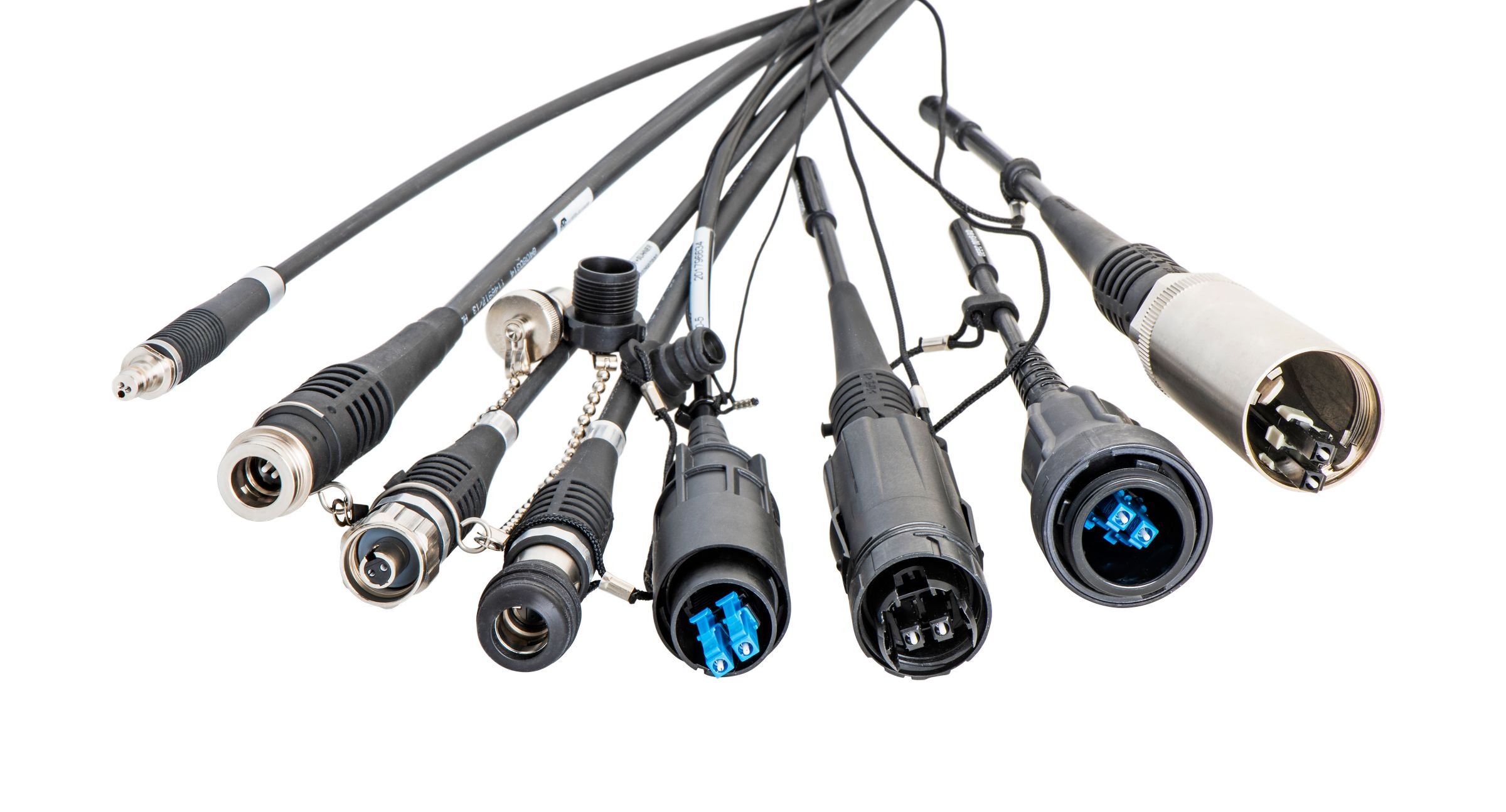
Pre-terminated hybrid cable assemblies can significantly reduce installation time and minimise the risk of field errors. For example, rugged solutions such as the H+S MLEH Hybrid 6×12 Full AXS Direct cable assembly combine fibre and power conductors in a single, robust assembly designed for outdoor deployment, making them well suited to connecting active equipment mounted on poles or street furniture.
Renewable energy installations, particularly wind turbines, present another demanding application. Fibre connectivity is used extensively for control, monitoring and condition reporting, and connectors must perform reliably despite vibration, temperature variation and limited access for maintenance.
Transport infrastructure presents similar challenges. Rail and road networks deploy distributed communications for CCTV, signalling and passenger information, often in locations subject to constant vibration, dust and weather exposure. In these environments, multi-fibre trunk and breakout assemblies can simplify network architecture while maintaining reliability.
Rugged assemblies such as the H+S MLE Masterline Extreme 24-fibre breakout cable are designed for exactly this type of application, allowing multiple services to be distributed from a single, mechanically protected backbone without extensive on-site termination work.
At the extreme end of the scale, underground mining and heavy industrial environments place exceptional demands on network components. In these settings, connectors must tolerate shock, contamination and mechanical abuse while maintaining low insertion loss and dependable performance over time.
Design approaches that improve long-term reliability
To meet these challenges, harsh environment connectivity solutions typically incorporate a number of design features that prioritise reliability over convenience.
Sealed connector housings protect interfaces from moisture and contaminants. Locking mechanisms such as push-pull or screw-lock designs prevent accidental disconnection and provide consistent mating force. Materials are selected for mechanical strength and environmental resistance, often using metal or reinforced polymer shells rather than lightweight plastics.
Pre-terminated cable assemblies are widely used to reduce installation complexity and variability. By minimising on-site termination, they improve consistency across large deployments and reduce the likelihood of performance issues caused by handling or environmental exposure during installation.
Compact connector designs also play an important role, particularly in space-constrained enclosures such as street furniture or turbine housings, where installation access is limited.
Thinking beyond installation: lifecycle reliability
When specifying connectivity for harsh environments, it is important to look beyond initial installation and consider how the system will be maintained over its operational life.
Questions worth addressing early in the design process include how often the connector will need to be accessed, whether maintenance will be carried out by specialist engineers or general contractors, and what the consequences of downtime would be at that location.
In many telecom deployments, harsh environment connectivity must also work alongside electrical protection measures. For installations involving active equipment at height or in exposed locations, this often includes coordinated lightning and surge protection strategies, such as those outlined in GCA’s technical guidance on remote radio head (RRH) lightning protection.
By considering these factors alongside environmental performance, engineers can select connectivity solutions that offer the lowest total cost of ownership rather than simply meeting minimum technical requirements.
Connectivity as a foundation of network resilience
As networks continue to move into more exposed and demanding environments, connectivity can no longer be treated as a secondary consideration. The choice of connector and cable assembly has a direct impact on network availability, maintenance effort and long-term performance.
Harsh environment connectivity solutions play a critical role in ensuring stable operation across telecom, industrial and infrastructure networks. When selected and deployed correctly, they help reduce failure rates, simplify maintenance and support reliable data transmission in conditions where standard connectivity would struggle.
By designing with these principles in mind, engineers can build networks that remain dependable long after installation, even in the most challenging environments.
Technical reference
This article is informed by established industry guidance and connector performance data, including the Harsh Environment Connectors – Overview technical documentation (Edition 2020/06), alongside publicly available engineering commentary on reliable network solutions for harsh environments.
For examples of suitable connectivity solutions, GCA supplies a range of industrial-grade products from Huber + Suhner designed specifically for demanding outdoor and industrial applications.